Run your entire business from one connected GST ERP.
GST billing, inventory, accounting, purchasing and reporting — connected in one simple workspace built around your day-to-day workflow.
Every part of the business, in one workflow.
Instead of separate spreadsheets and disconnected tools, the ERP brings each business function into one connected system.
Billing & invoicing
GST-structured sales invoices with customer, product and payment detail.
Inventory
Categories, units, pack/loose UOM and live stock tracking.
Purchasing
Supplier-to-stock purchase flow tied directly to reporting.
Customers & suppliers
Contact records, payments and outstanding balances in one place.
Reports & analytics
11+ report types covering sales, purchase, stock and dues.
Banking
Bank accounts, transactions and statements, reconciled together.
GST ready
Group GST handling built into billing and purchase records.
Employees
Attendance, payments and payment-slip generation.
Features
Everything you need to run day-to-day business operations — connected in one modern workspace.
Designed for Your Industry
Flexible business management tools for the unique workflows of a wide range of industries.
Built for businesses that want less busywork.
Give your sales, billing, inventory and accounts teams one connected place to work.










See how the GST ERP can fit your business.
Get a practical walkthrough of billing, inventory, accounting and reports based on your workflow.
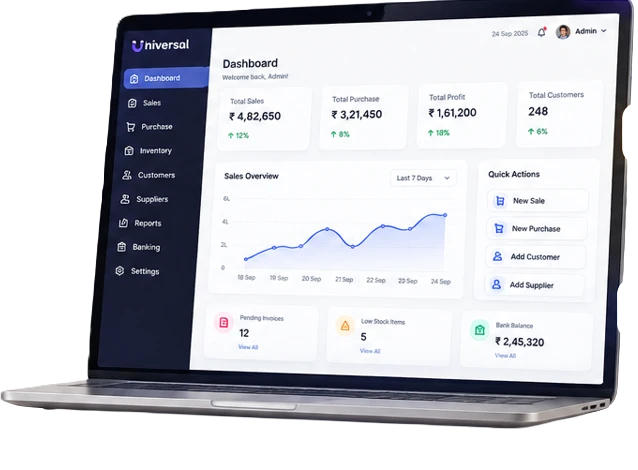
One dashboard. A clearer view of your business.
Give your team one place to understand sales, purchases, stock and outstanding payments — without jumping between disconnected tools.
One transaction. Every business process stays connected.
Instead of treating billing, purchasing, inventory, payments and reporting as separate tasks, the ERP connects them into one continuous business workflow.

Create the sale
The process starts at the billing counter. Customer, product, quantity, pricing and GST details are captured in one invoice.
One entry should create value across the system.
The important part of the ERP is not simply having more screens. It is how one business action connects the next one.
From scattered records to one operating system.
The goal was not to add another software layer. It was to bring the important parts of the business into one connected workflow.
Disconnected day-to-day work
Business activity could easily become fragmented when different records and processes were handled separately.
One connected business workflow
The system brings the operational chain together so information can move naturally from one business activity to the next.
Each role sees the part of the business it needs.
The interface is structured around the people actually using the system — not around technical modules alone.
Business overview
Sales, purchases, stock, outstanding payments and reports can be viewed from a centralized business perspective.
Dashboard & reportingFast transaction entry
Customer, product, quantity, pricing and GST information can be captured through the billing workflow.
Billing & GSTStock visibility
Products, quantities, units, purchase activity and stock movements stay part of the same operational system.
Inventory & purchasingFinancial control
Outstanding balances, collections, banking activity and accounting reports remain easier to follow.
Payments & accountsBuilt around what happens after the transaction.
A business does not stop at creating an invoice. Returns, collections, banking, adjustments and staff activity continue every day. The ERP brings those activities into the same workflow.
From “something happened” to “the system knows what happened.”
Operational events become structured records instead of scattered notes, spreadsheets or disconnected follow-ups.
Financial follow-through
Outstanding balances, collections, payment records and banking activity remain part of the same business trail.
Payments → Banking → ReconciliationCorrections without breaking the flow
Returns, replacements and operational adjustments can be handled as part of the system instead of outside it.
Return → Adjustment → Updated recordsNot a collection of modules. One business system.
The architecture is designed around relationships between business activities. Products influence stock. Sales create invoices. Purchases affect inventory. Payments affect balances. Reports bring the whole picture together.
Sales overview
Sales activity across the selected period.
Business activity
Key records
What businesses using it say.
Replace these placeholder quotes with real client feedback.
“The billing process has become much easier. We can create GST invoices quickly and keep track of our daily sales and stock from one place.”
“GST reports and sales summaries are much easier to manage now. Instead of checking multiple records, everything is available in a single system.”
“The software is simple to understand and the interface is easy for our staff to use. Stock, purchases and customer billing are much more organized.”
Your business deserves software built around it.
We design and develop custom ERP, GST, billing and business management software around real workflows. Tell us a bit about your business and we'll get back to you.